
Shopping Cart
There are no more items in your cart
- Essential oils for beauty and hygiene
- 1 likes
- 12930 views
- 0 comments
Creating your own perfume with essential oils has several advantages. First of all, it's a creative activity. Over time, you'll learn to identify aromas and imagine combinations of 2 or 3 essential oils. Secondly, you'll have the satisfaction of wearing your own creation, rather like making your own clothes, rather than one of the mass-produced perfumes. Finally, you'll be sure to use only natural products.
If you're just starting out in perfume creation, the following guidelines may be useful before you begin. You need to know: i) concentrations, ii) ingredients and iii) notes. We'll then give you a few perfume examples and recipes.
Let's start with the subject of concentrations
Perfume is an aromatic composition containing between 15 and 30 percent essential oils, compared with a water/alcohol mixture of 85 to 70 percent (the proportion of water can vary from 5 to 10 percent).
What we call eau de parfum will be less concentrated in essential oils (8 to 15 percent), while the remaining part (85 to 92 percent) will be slightly more concentrated in water (at the expense of alcohol).
Next come eau de toilette (4 to 8 percent essential oils) and eau de Cologne (3 to 5 percent essential oils).
The ingredients
For the ingredients, use 100% pure (and natural, of course) essential oils, distilled water (found in pharmacies) and perfume alcohol (found in our stores). For the bottle, use a brown or totally opaque glass bottle to protect the essential oils from light. You'll also need a dropper, a spray pump and an ml measuring pipette. All these accessories are available on this site. Don't forget to write down your compositions in a notebook (percentages, number of drops, etc.), as you may need them to renew or modify one of your creations.
Depending on the concentration of essential oils, you'll obtain a different aroma intensity. The fragrance is denser and, above all, lasts longer on the skin. But not everyone wants or needs to exhale the same fragrance at every hour of the day. That's why eau de parfum is the more discreet choice.
Depending on your choice of essential oils, you may find that fragrances are dynamic products that change over time. The fact that evaporation rates vary from one essential oil to another explains this phenomenon. A well-designed perfume combines essential oils to avoid these variations. This is achieved by using fixative essential oils, which have the property of holding together the aromas you wish to marry.
The notes
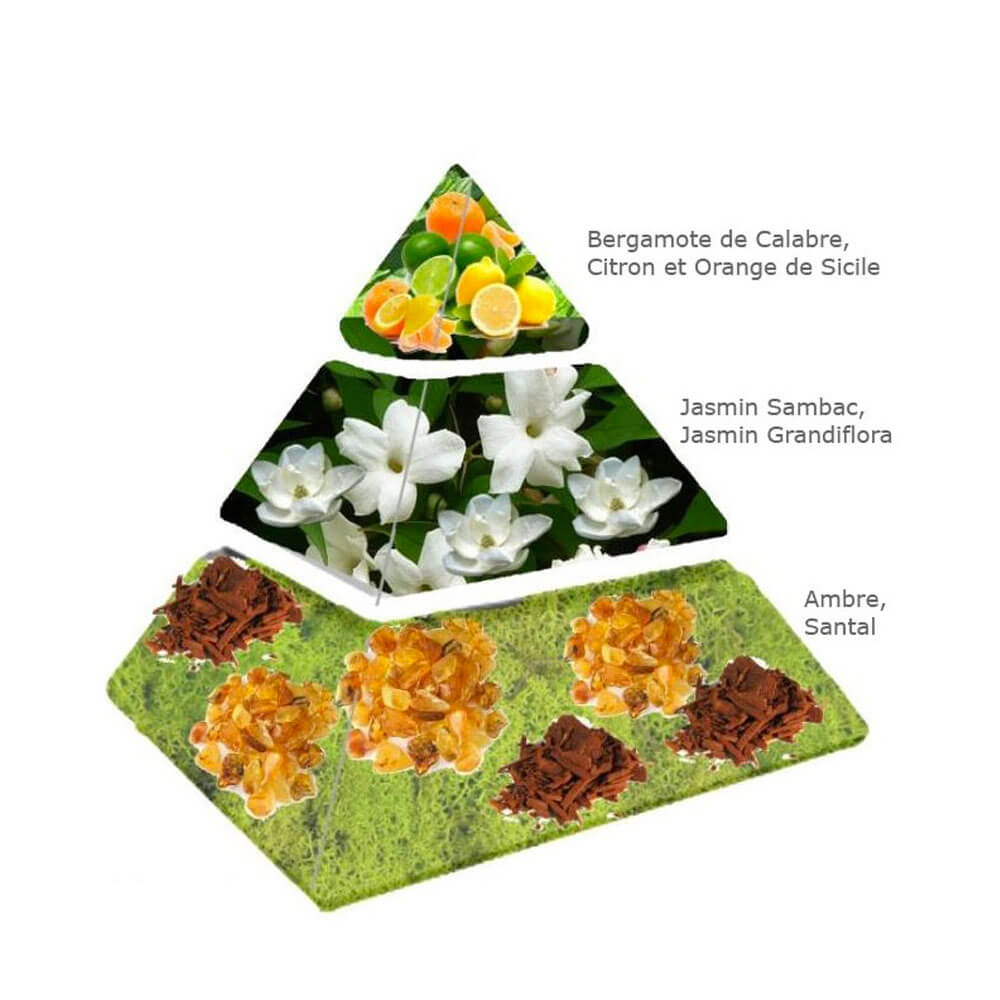
To create a perfume worthy of the name, you need to combine 2 or 3 types of essential oils: "base notes", "heart notes" and "top notes" essential oils.
 |
|
|
Base notes |
Heart notes |
Top notes |
|
|
|
Some perfume recipes
Recipes from the book "Des Parfums à faire soi-même" by N.de Barry.
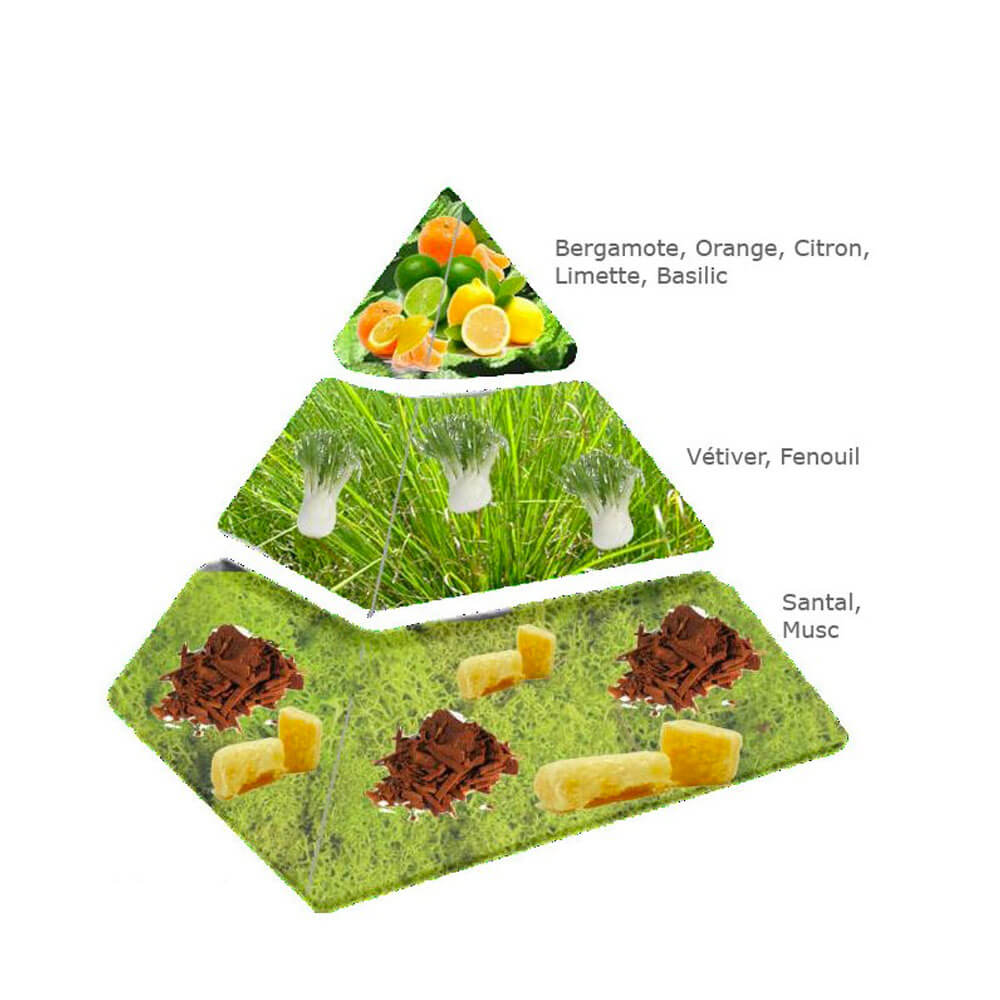
Oriental fragrance
|
Ingredients:
|
 |
Classic Eau de Cologne
Ingredients:
- 100 ml alcohol
- 4.5 ml Neroli essential oil
- 3 ml Rosemary essential oil
- 7 ml Orange essential oil
- 7 ml lemon essential oil
- 4 ml bergamot essential oil
To use:
Mix the above ingredients and leave to stand for a month. To glaze, leave the bottle in the freezer overnight, then filter through a paper filter (special for perfumeries). Your perfume is ready! We recommend, however, that you let your perfume mature for a few months before using it.
Other recipes ...
Heady, suave feminine fragrance
Ingredients for 100 ml of perfume:
Base note :
- 9 ml Sandalwood essential oil
- 5 ml Cedar essential oil
Top note :
- ten drops of lemon essential oil (or bergamot, ylang-ylang).
Add 4 drops of Sage essential oil as a fixative.
Gentle, enveloping feminine fragrance
Ingredients for 100 ml of fragrance:
Base note :
- 3 ml Cedar essential oil
Heart note :
- 7ml Geranium bourbon essential oil
- 20 drops Damask rose essential oil
Top note:
- 4ml verbena essential oil (4 ml)
Add 4 drops of Sage essential oil as a fixative. Rose and Geranium essential oils have relatively similar fragrances and complement each other perfectly.
Eau de Cologne recipe examples
Mix the ingredients of your formula in a tinted glass bottle (100 ml) according to the table below. Close the bottle tightly and leave the mixture to stand for 3-4 days, protected from light and heat. Add 80 ml of pure vodka and shake gently to mix all ingredients. Leave to stand for 2 days before adding two tablespoons of spring water. Let stand again for at least 2 days (a rest of 4 to 6 weeks is ideal to allow your blend to mature). Then strain the mixture through a filter (such as a paper coffee filter) into its final bottle. If the fragrance seems too strong, you can add a little spring water.
We offer 3 formulas for making your own eau de Cologne:
Formula N° 1
- Petit grain essential oil: 2 drops
- Orange essential oil: 20 drops
- Lemon essential oil: 10 drops
- Rosemary camphor or cineole essential oil: 2 drops
- Bergamot essential oil: 10 drops
Formula N° 2
- Rose essential oil: 4 drops
- Lemon essential oil: 2 drops
- Orange essential oil: 2 drops
- Basil essential oil: 1 drop
- Neroli essential oil: 1 drop
- Petit grain essential oil: 1 drop
- Bergamot essential oil: 2 drops
Formula N° 3
- Palmarosa essential oil: 10 drops
- Orange essential oil: 8 drops
- Petitgrain essential oil: 3 drops
- Lemon essential oil: 2 drops
- Geranium essential oil: 1 drop
Perfume training
Nicolas de Barry offers training courses for people who want a short, but intensive and practical course to acquire a basic knowledge of how to create perfumes, and how to make them by hand. But it's also very interesting for any perfume novice wishing to learn more.
 |
|
Comments (0)